
CRACK BELLMER
About the Project
Crack Bellmer is a club on the RAW site in Berlin-Friedrichshain and an established venue for music events and nightlife. The club is located directly next to residential buildings, making it part of an urban environment where club operations and residential use are closely connected.
Initial Situation
In the past, there were repeated conflicts with local residents. In particular, a newly converted attic apartment in a residential building opposite the club created a direct line of sight and sound towards the club’s indoor and outdoor areas. Low-frequency sound was a particular problem. Restrictions on volume levels and the use of the outdoor area were able to ease the situation temporarily, but significantly limited the club’s cultural and commercial operations.
Measures
1. Directional Bass Sound System
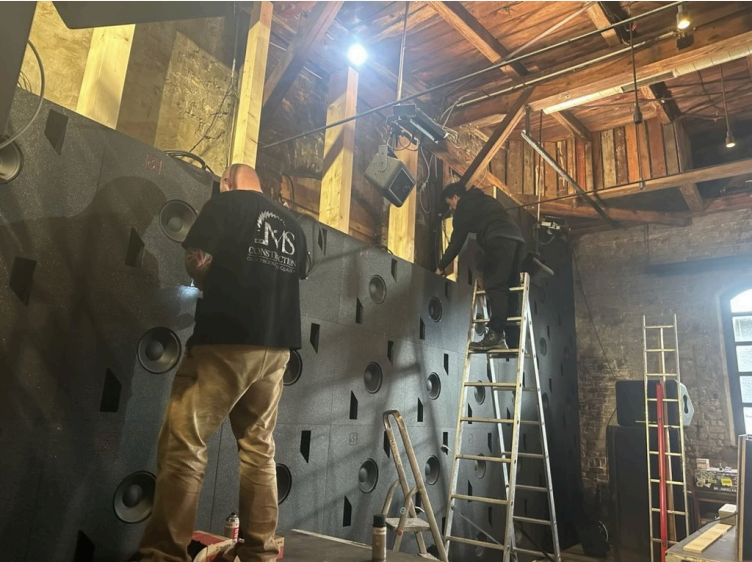
The core of the project was a specially designed bass array. The low-frequency sound system is specifically directed towards the dance floor, while sound radiation towards the relevant measurement points is reduced. The originally planned construction was further developed during the project and implemented as an optimized bass-reflex design. A total of 56 custom-built bass speakers were installed.
2. Absorbers and Acoustic Optimization
Additional slotted-plate resonators and porous absorbers were installed. Existing surfaces around the bar and rear wall were also used as sound-absorbing surfaces. This helped reduce reflections within the room and minimize the excitation of adjacent building structures.
3. New Entrance Doors
The existing entrance doors were completely replaced with sound-insulating doors. The old doors had been a particular weak point in terms of airtightness and sound insulation.
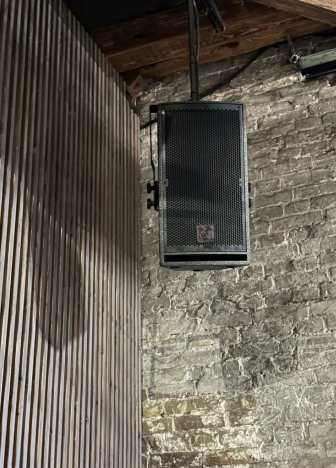
4. Distributed Sound System for Mid and High Frequencies
Several speakers provide a more even distribution of mid and high frequencies throughout the room. This helps avoid individual sound peaks and allows the music to be played at a lower overall level.
Result
The soundproofing situation was significantly improved. Comparative measurements under reproducible conditions showed that the directional low-frequency system reduced the excitation of the building envelope and sound radiation towards the relevant measurement points. At the same time, sound quality inside the venue improved.
Since the measures were implemented, there have been no complaints about low-frequency sound emissions. Feedback from the surrounding neighborhood has also been consistently positive. Overall, the project has been highly successful and contributes to securing the venue’s long-term operation.