
MUSIKBRAUEREI
About the project
The Musikbrauerei is located in the historic Schneider brewery. With the construction of the Schweizer Garten, a residential complex with town houses and apartment buildings, and the division of the former brewery building, a new conflict situation emerged. One half of the building was converted into privately owned apartments by an investor. As the two parts of the building are physically connected, sound can be transmitted between them. The bedrooms were built directly next to the adjoining wall, further increasing the potential for noise conflicts.
Initial situation
A major challenge for the Musikbrauerei was structure-borne sound. Due to the connection between the two parts of the building, vibrations could spread throughout the building. A hammer test was used to identify the transmission path of the structure-borne sound towards the neighbouring bedrooms.
Measures
1. Reduction of the indoor sound level
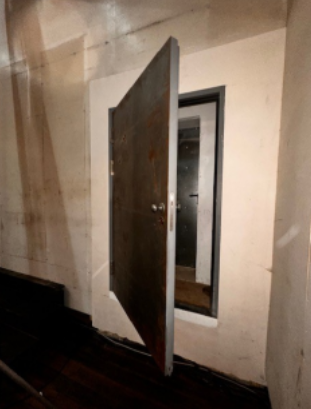
To avoid permanent and excessive limiting of the sound system, the first step was to reduce the indoor sound level and improve the building acoustics in order to minimise airborne sound leaving the venue. Sound absorbers were installed, bass traps were integrated into the floating floor, and the existing doors were replaced with soundproof doors.
2. Additional acoustic insulation
A limestone wall with a soundproofing vestibule was built to further reduce sound transmission. A broadband absorber wall, financed by the venue itself, also significantly reduced the indoor sound level.
3. Soundproofing of the upper-floor window
A soundproof window was installed on the upper floor because the wall at this point acted as a transmitter for sound waves, particularly low-frequency sound, into the hallway. Together, these measures significantly reduced airborne sound.
4. Separation of the building structures
Additional measures were carried out in the Schwankhalle using the venue’s own funds. The aim was to separate the connections between the two parts of the building as far as possible, or to partially interrupt them, in order to reduce the energy transmitted as structure-borne sound.
This included closing all wall cracks and openings, creating a separation cut between the walls and the floor, carrying out three complete foundation wall cuts with structural reinforcement, and removing beams and boards connecting the walls and roof.
5. Roof and ceiling construction
The roof was renewed, with the wall connections using a flexible rubber membrane (Hertalan) instead of the previous rigid bitumen sheeting. The ceiling grid supports were also raised and mounted on vibration-isolating materials.
6. Flexible soundproofing elements
Ten Wax-shape panels were installed as flexible elements that can be used according to the specific noise situation to further reduce sound emissions.
Result
The combination of the measures significantly reduced both airborne and structure-borne sound. The extensive improvements helped to reduce sound transmission between the venue and the neighbouring residential area while allowing the sound system to be operated without relying solely on permanent and excessive sound limiting.